

Why does Vado, N.M. keep flooding?

The community of Vado was severely inundated during a July 22, 2025 storm, as seen in this screen capture of a video presented to the Doña Ana County Board of Commissioners in an emergency meeting focused upon the disaster. Vado, located downstream of a series of arroyos that channel run-off from nearby mountains, is at risk for ongoing flooding during storms. Image: Doña Ana County government
July flood is 1 of 7 to strike this southern Doña Ana County colonia over two decades
VADO – Rain clouds are often a welcome sign in New Mexico, where drought is common and residents enjoy a bit of rainy weather. But in southern Doña Ana County, rain in the forecast can be an ominous warning of flooding.
Hortencia Rodriguez has lived on Flower Road in Vado for about 30 years. Floodwaters spared the inside of her mobile home this summer, but the surrounding yard was full of water, she said in Spanish. She told the Southern New Mexico Journalism Collaborative that her sons, who live nearby, had to acquire a pump out of their own pockets to remove the standing water from her yard. She said her neighbors had it worse, but everyone had difficulty getting through the mud.
Rodriguez said July’s flood has her thinking about leaving Vado for another small, nearby community where her children live and do not deal with the severity of problems she does. She described in Spanish feeling “on edge” and losing a sense of “calmness” in her home.
The community of Vado, a Doña Ana County colonia located about 20 minutes south of Las Cruces along Interstate 10, was the latest area to experience a significant flooding event. The unincorporated community nestled on the Rio Grande was overwhelmed with water the night of July 22, prompting evacuations, emergency rescues, power outages to 600 homes and damage to over 100 homes.
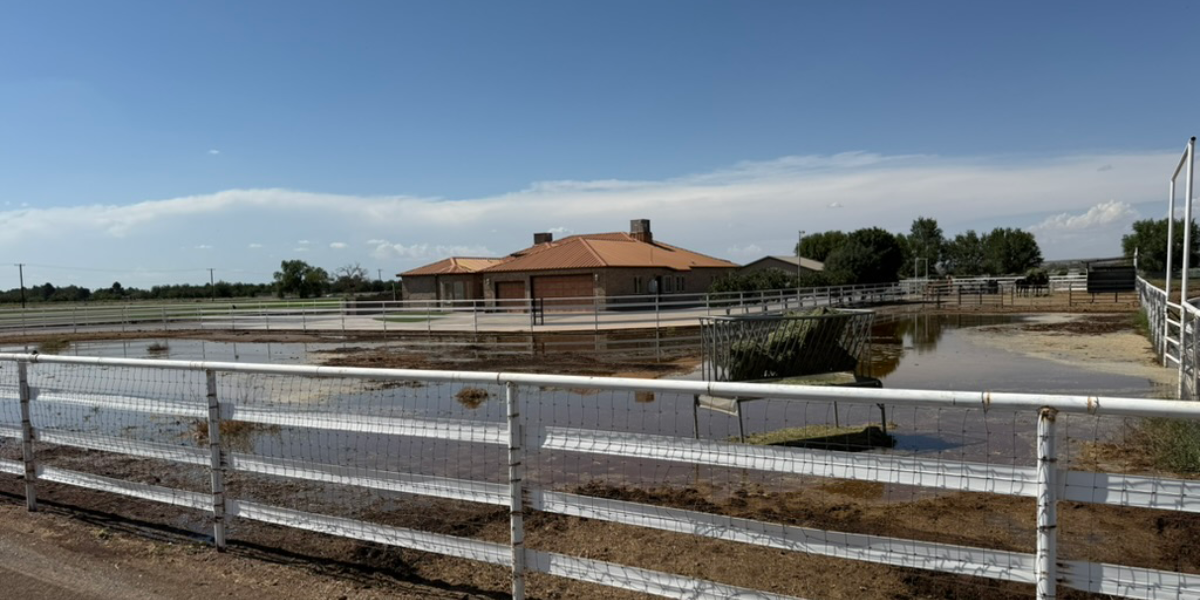
A Vado, New Mexico property is seen covered in standing water. (Photo by Leah Romero/ SNMJC)
The disaster was one of at least seven major flood events to inundate the Vado-Del Cerro community since 2004, according to the county. Topographical hazards – nearby mountains whose run-off drains directly into the low-lying community of Vado – combine with a lack of infrastructure to pose significant risks to residents’ safety and their property during summer storms. This risk will continue until Doña Ana County officials – county commissioners, likely in partnership with state lawmakers – fund significant improvements to curtail the water flow or shunt it more safely to the Rio Grande – action that so far seems to be substantially lacking.
Downpour hits mountains, floods Vado
Greg Lundeen, meteorologist in charge for the National Weather Service station in Santa Teresa, explained that the Vado area received between 2 and 2.5 inches of precipitation on July 22. The nearby Organ Mountains received between 2 and 3 inches of rain, which then drained into the valley, over I-10 and into Vado, where it overwhelmed canals and drainage infrastructure.
“This rated out … as a 50- to 100-year rain event, average return interval,” Lundeen said. “ Vado is one of those areas that’s a little susceptible to heavy rains…The water does not drain very quickly out of that area.”
He said residential and other infrastructure “interferes with that natural flow” of water toward the Rio Grande. He also added that July’s flooding event was more extreme compared to other recent rain events in the area, however New Mexico’s monsoon season has been more active this year. Climate change could be a factor, he said, but these rainy weather patterns are largely impacted by patterns over the Pacific and Atlantic oceans – some years are naturally more active with rain than others.
“This season has been more active than past years because we were very dry, exceptionally dry the last few years, with a couple exceptions. And so this is actually a much more of a return to normal,” Lundeen said. “There are so many different factors that come into play before a rainfall in this area. Climate may be one of them, but sometimes it's just decadal oscillations out in the Pacific or the Atlantic [oceans].”
He explained that these climate patterns impact the “general flow of moisture” over southern New Mexico and can lead to years of drier weather, or the opposite. Lundeen recalled that 2022 was a similarly fairly active rainy season, though the rainfall was more focused toward the west of the Rio Grande.
Vado repeatedly struck by flooding
The recent flood was one of many that have struck the Vado-Del Cerro area over the past two decades. According to Doña Ana County’s 2021 All Hazard Mitigation Plan, Vado has experienced significant flooding events in June 2004, August 2006, July 2013, August 2013, September 2013 and August 2014. Several of these events involved evacuations, loss of homes and emergency declarations by then Gov. Bill Richardson. Doña Ana County was named in federal emergency declarations in the 2006 and 2013 events, according to the plan document.
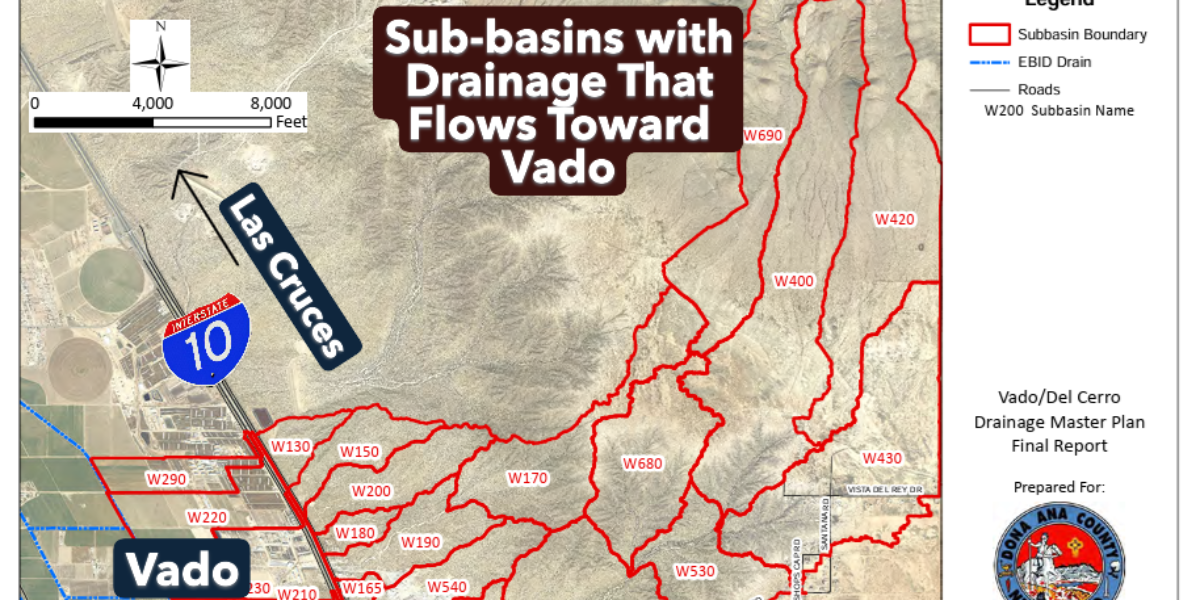
This map showing sub-basins whose drainage flows into Vado was included as part of an engineering study carried out on flooding in this south-county colonia. (Image: Doña Ana County government)
Lorena Velasquez lives in Mesquite, just north of Vado, but she said in Spanish that she has her share of difficulty in dealing with flooding. She pointed to a flood in the early 2000s where standing water was above her knee in some areas and people were swept away by the fast-moving water.
She said she lived in Vado at the time and had young children. Water and hail wiped the roof from her home during that event and she described the sewer system "erupting" as floodwaters overwhelmed the infrastructure. Velasquez said she grabbed her children, a few bags of personal items and sought refuge in her car.
Velasquez said she has “struggled” too hard over the years for her land in the south valley to leave it. She called it her “American Dream” and is proud of her property. However, she did suggest mobile homeowners find a way to better fasten their homes to the ground so there is less movement when floodwaters travel through.
Gov. Michelle Lujan Grisham signed an emergency order on July 25 in response to the Vado flooding, which directed the New Mexico Department of Finance Administration to provide $750,000 to the Department of Homeland Security and Emergency Management for recovery efforts.
Doña Ana County Flood Commission Director John Gwynne told the collaborative that much of the Mesilla Valley is susceptible to the same problem: rain runs off the mountains and into residential areas where the land flattens leading to ponding.
“We have mountains and escarpments that are above the communities, and as the water comes out of the desert into the communities, it's moving very fast until it hits the community. And then because it flattens out in the community – the ground does – the water tends to slow and it just creates all kinds of problems,” Gwynne said.
Flood control in Vado relies on irrigation district’s drain
Gwynne explained that flood control structures in the Vado area include culverts that pass under I-10 and storm drains in residential streets, both of which direct water to channels that lead to ponding areas in the desert outside residential areas. Outlet pipes allow water to drain from the ponding areas into the Elephant Butte Irrigation System’s drain, which Gwynne added are not inherently made to divert storm water. The irrigation district’s system is meant to deliver Rio Grande water to farm land.
“Our infrastructure relies on the Elephant Butte Irrigation District’s drain to get the water out to the river. Now, that drain was never designed for storm water and so putting storm water in there is not efficient,” Gwynne said. “We need to work with the irrigation district and [the New Mexico Department of Transportation] and we need try to find ways to find better pathways to get this storm water out to the river…There’s a lot of things that we have to jump through, a lot of hoops we have to jump through to keep things functioning, and so we will probably spend the better part of this year in just repairing the damage to [the northern most ponding area] and to the other structures that were damaged as part of this process.”
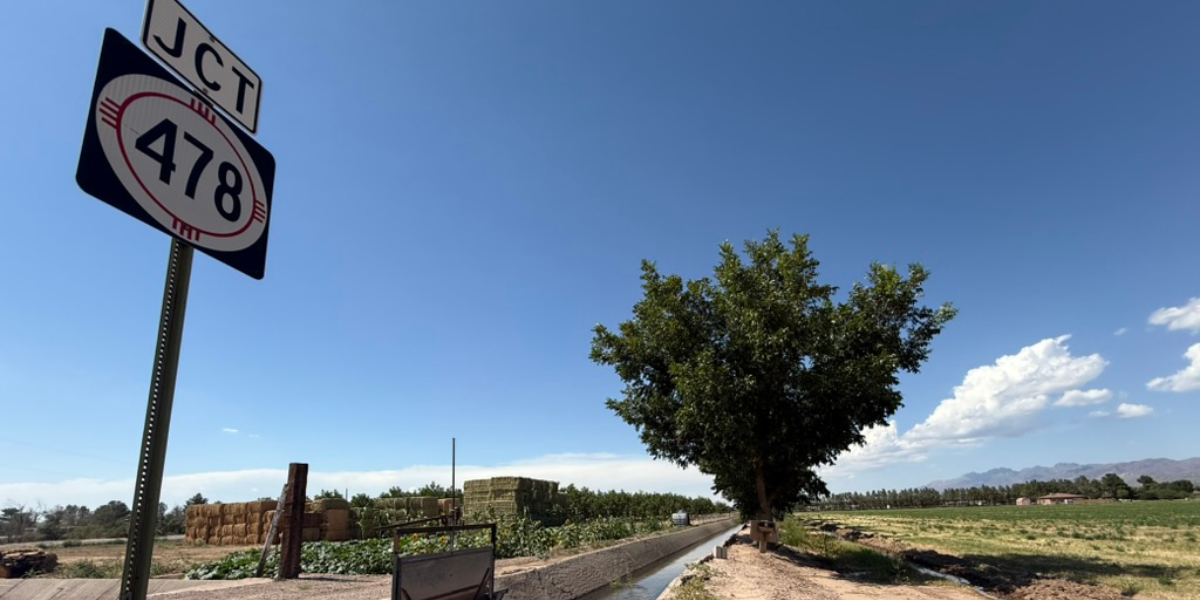
A ditch is seen near Hwy. 478 in the vicinity of Vado, New Mexico. Irrigation structures that weren’t meant as flood control structures are one method being relied upon to remove water from Vado when it floods. (Photo by Leah Romero/ SNMJC)
Another compounding factor, Gwynne pointed out, was the large amount of sediment and dirt the rainwater pulled from the desert, which clogged some of the I-10 culverts, as well as the EBID infrastructure.
Velasquez said the rain also brought a lot of wildlife from the desert into the village, including “culebras” or snakes.
Flood commission lacks funding for improvements
Gwynne added that several manholes were also uncovered, which are not watertight anyway, so more debris and storm water entered the wastewater system and overwhelmed it. Several wastewater lift systems and pumps were damaged and will likely need to be replaced, Gwynne said.
And because much of the flood infrastructure overlaps with NMDOT and EBID, Gwynne said it can take a lot of time and money to manage, build and repair structures.
“It’s a matter of coming up with a plan that works for everyone, and so it’s complicated at best,” he said. “Our plan is to continue to improve every year as we get funding. Our revenue streams are very minimalistic and the only way we can actually build these structures is if we get grants.”
Gwynne also told the collaborative that the land east of I-10 is a difficult area to work with as the Vado Quarry takes up a lot of space, as well as multiple arroyos located farther upstream. Ponding areas are difficult to construct in these areas with changing elevation. He added that building a dam to stop the rain from running down from the mountains and into the community would require hundreds of millions of dollars. He asserts it is just not feasible.
“You could build Hoover Dam up there, but you’d spend so much money on the dam that you would be better off moving all the people out [of the community], which is never popular and it’s not a good for the economy or anything else,” Gwynne said.
He explained that the commission’s flood control designs are based on “a storm that has a recurrence interval of one chance in 100 years,” or a 1% probability rate during a given year. However, it is possible for areas to experience multiple “100-year storms” in one season. “It’s a bit of a misnomer,” Gwynne said. “When you do engineering for these things, you're basing it on probabilities and Mother Nature doesn't comply very easily with our mathematical probabilities… You could build for a bigger storm, but what happens is then the economics begin to override what you're trying to protect.”
State funds made up part of the commission’s budget, Gwynne said, but Doña Ana County encompasses several thousands of square miles and the commission needs more assistance to complete the various unfinished and pending projects in areas including Salem, Hatch, La Union and Doña Ana village. He explained that the Legislature’s capital outlay system can be difficult to navigate and the flood commission only receives part of the funding amount it asks for each year.
“And if you try to do half of a flood control project, you typically actually cause more damage than you solve because you’re focusing the water into a given area,” he said. “We can’t really start a project until we have enough funding to phase it properly. And so what that means is you then have to wait another year until the next legislative cycle to see if you can get some more dollars.”
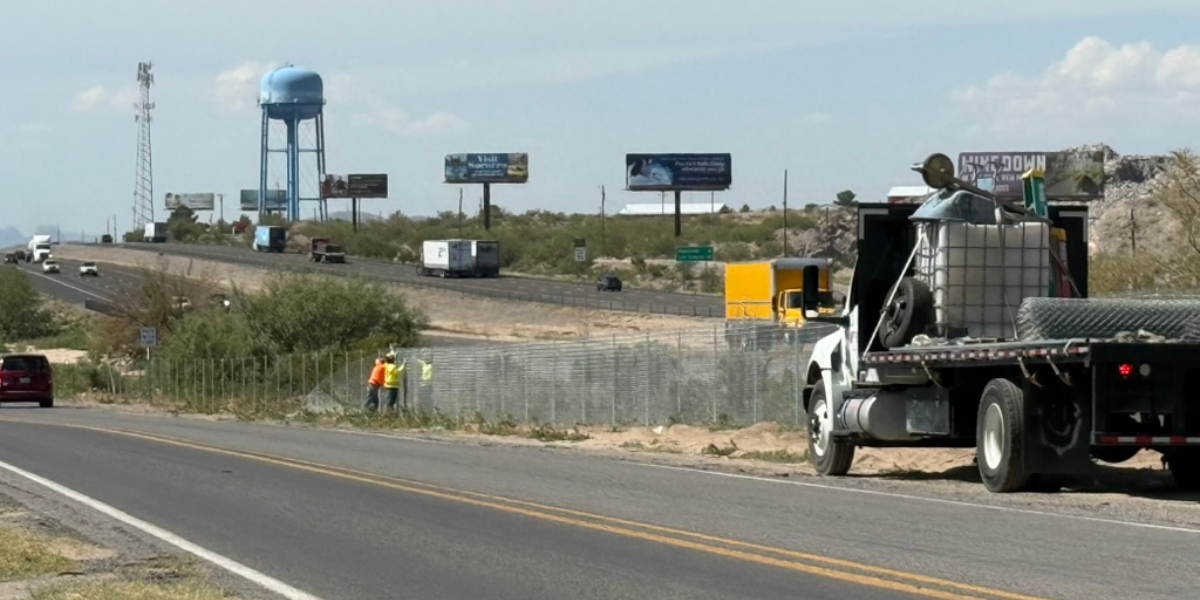
A work crew makes repairs after severe flooding struck Interstate 10 and the adjacent community of Vado-Del Cerro on July 22, 2025. (Photo by Leah Romero/ SNMJC)
Gwynne described it as “piecemealing” funding together for projects. He said acquiring permits for construction projects and property also slows down the process.
Doña Ana County Commissioner Christopher Schaljo-Hernandez, chair of the board of commissioners, told the collaborative that communities like Vado and other colonias were formed in areas that the county now knows have issues with flood zones, arroyos and other diversion tactics.
“The issue is that now that we know this, we need to make sure that we’re actually helping our community members, helping people that are looking at building or moving or doing anything like that to prevent them from building in bigger areas of floodplains, arroyos,” Schaljo-Hernandez said. “We’re starting to right a lot of the wrongs that we’ve seen generationally.”
He explained that the county alone cannot afford to completely fund all of the flood commission’s projects, and support needs to come from the state and federal government as well to accelerate the projects. He added that funding such projects is not just a problem for Doña Ana County, but the entire state.
“I know, as being a county commissioner, that if we just allocated all of our funding to flood projects for the next three years, we can maybe make a huge dent in a lot of this, but then we wouldn’t have any money for infrastructure or for everyday needs like roadways, utilities, water,” he said, noting that the projects are still a priority for the county. “The need of the flood commission is monumental, like hundreds of millions of dollars and … it’s not something we just have lying around to get these done.”
County Commissioner Susanna Chaparro did not respond to SNMJC requests seeking comment on the Vado flooding.
What can residents do for themselves?
From a homeowner’s perspective, planning for flood events can be difficult because it all depends on the severity of the event and July’s storm was “abnormal,” according to Gwynne. He said people may be inclined to elevate their mobile homes to help divert or deter water from entering, but the water still needs somewhere to go.
“You have to be careful because if you build flood protection measures around your own house and now that water is diverted from your house and it floods your neighbor, and you could be held responsible for that,” he said. “It's tricky business. Water is tricky business…It actually took days for the water to get out of the community because the systems were all overwhelmed. And so preparation is a tough thing.”
Gwynne suggested people stay aware when rain is forecasted and pay attention to weather and warning systems. The Doña Ana County Flood Commission has a flood warning system available online, which is informed by 80 weather stations monitored 24/7 in the county. People should also listen to first responders. He said emergency crews were on the ground in Vado encouraging people to evacuate, but some people chose to stay.
The master drainage plans, developed as a guide for the commission to determine which projects will be completed next, are available online for the public to view.
Maria Hernandez, another Vado resident, has lived in a home on Boyer Road for about 28 years with her family. She told the collaborative in Spanish that while water did not seep into the main house last month, it did enter her garage. She worries it may have caused problems with the foundation of her home. She can also still smell sewer water when she steps outside her home.
Hernandez agreed that there is not too much people can do to prepare their homes for flooding. Instead, she lives day-by-day. Her family moved to the area from Houston almost 30 years ago and she found Vado to be a much safer place to live. And her children have thrived – one earned a doctorate degree and the other attends New Mexico State University.