

New Mexicans receive first $100K payments under radiation exposure law
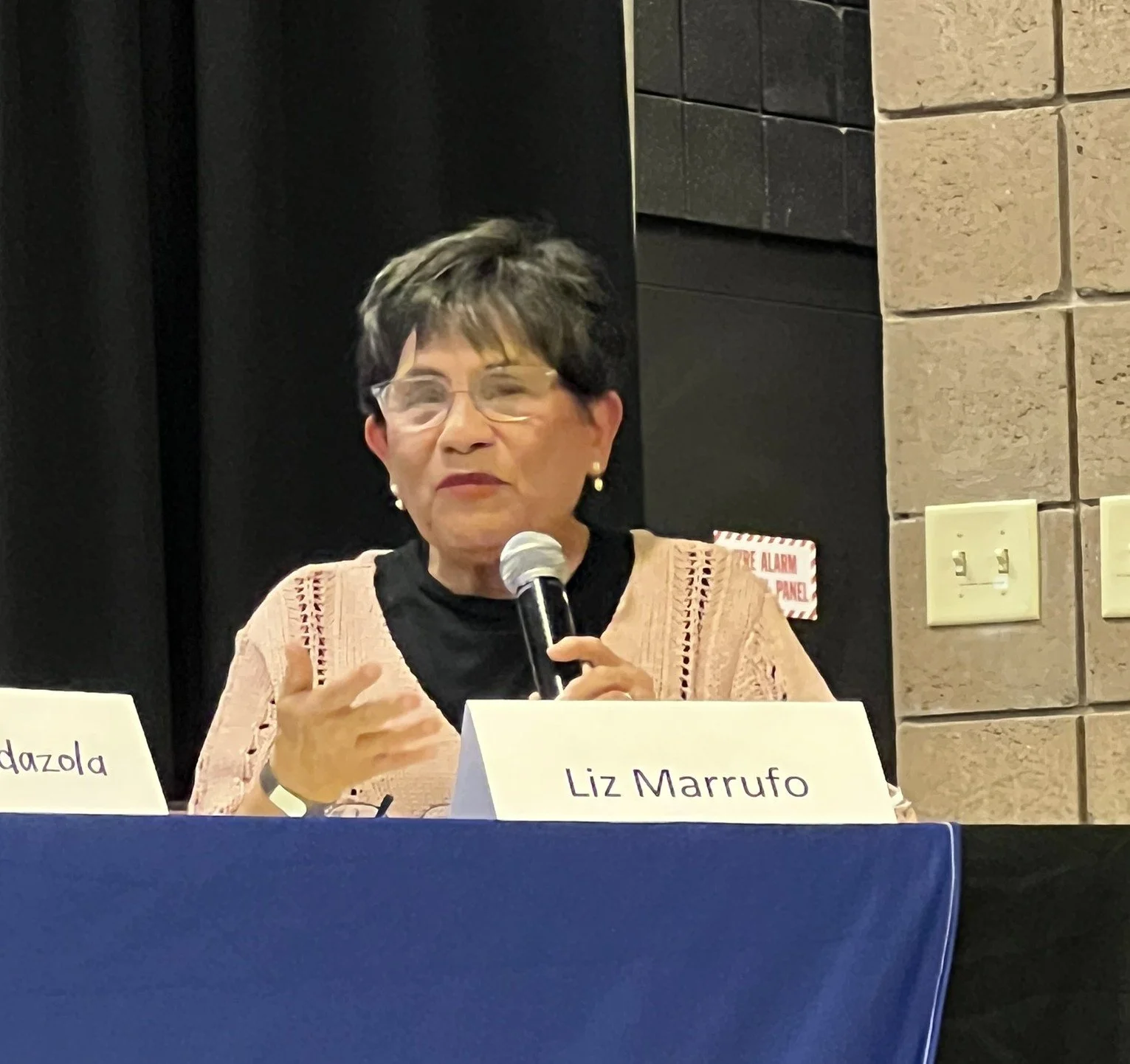
Liz Marrufo is an advocate and volunteer who has received compensation under last year’s Radiation Exposure Compensation Act, or RECA. She spoke about her experience applying during a forum held Feb. 1, 2026, at Doña Ana Community College in Las Cruces. (Photo by Elva K. Österreich)
SOUTHERN NEW MEXICO – Many New Mexicans who survived cancer or had family members die from cancer have already received compensation from the federal government in connection with historical nuclear testing, namely the detonation of the world’s first atomic bomb near Socorro in 1945.
The relatively new law known as the Radiation Exposure Compensation Act, or RECA, expands a previous federal program that pays money to people who experienced cancer in certain geographic areas because of radiation exposure. The law, passed last summer by Congress, authorizes one-time, lump-sum payments of $100,000 to people who qualify as so-called “downwinders” in New Mexico.
Though it took about half a year for the federal government to set it up, a digital portal for New Mexicans to file claims is now open.
So far, nearly 9,100 downwinder claims have been filed with the U.S. Department of Justice, according to its website. Of them, nearly 1,200 have been approved for a total of $118.2 million in payments altogether. No claims reviewed have been denied yet, according to the site.
Notable about last year’s expansion is that any New Mexican who lived in the state during a certain time window and who developed any one of a list of cancers is eligible to apply for compensation – not just the people who lived near Trinity Site, ground zero for the detonation.
NM resident files successful claim
Retired educator Liz Marrufo is among those New Mexicans who’ve filed a downwinders claim – and already received payment for it. She shared her experience at a RECA outreach forum Feb. 17 in Las Cruces that was led by U.S. Sen. Ben Ray Luján.
“From start to finish, my own application took 38 days,” she said. “From the time I submitted it, all the way to receiving the compensation was within 38 days.”
After Marrufo retired from her 38-year career as an educator, she happened to attend a meeting where she heard Mary White, a volunteer advocate with the Tularosa Basin Downwinders Consortium, present about RECA. That inspired Marrufo to read more about the issue. And, when the compensation bill finally passed, she realized she was eligible to apply.
“I thought, ‘I have had cancer, and I’m qualified under the RECA program,’” she said. “So I
began working on the packets, getting my documents to prove my father and myself had lived in New Mexico.”
Two of the key elements to apply for compensation as a “downwinder” are that someone lived in lived, worked or went to school in New Mexico for at least one year between Sept. 24, 1944, and Nov. 6, 1962, and that person had at least one of the 19 compensable cancers. Applications require that evidence – like birth certificates, marriage records, and school documents – be filed along with a claim.
If someone died from a qualifying cancer, their heirs can file a claim.
In addition to the downwinders, residents of the northwest part of the state who worked in uranium mines are included in last year’s expanded version of RECA. They can qualify for a larger amount of compensation, and there are different ailments on that list.
Marrufo got involved by contacting Tina Cordova, co-founder of TBDC, and expressed interest in helping people complete their applications. She attended a Zoom training and realized her own documents were ready to submit to the federal government. She filed her own application to RECA. And then she set out to file another for her father, who also qualified to apply.
“My father’s application, it took a little bit longer,” she said. “His whole process took 50 days.”
$5 billion available to pay claims
Cordova said Congress allocated $5 billion for RECA claims when the legislation passed.
When RECA was first established in 1990 to compensate people from other regions, it ran out of money a couple of times, Cordova said. Then Congress had to up the budget for it. So, what they do is put some money towards it in a budget and, when it needs more, they have to allocate more.
“There was a time in the past when they were giving people IOUs because they were
out of budget money,” Cordova said. “Then when the Congress finally passed additional
budget money for it, they sent the people their check. But right now, it’s got $5 billion in the budget for it, so until they reach $5 billion, people are going to get their money.”
Just a week after the DOJ opened its online portal, more than 3,000 claims were filed, according to Cordova.
“That tells me there were a lot of people waiting for the online process to file a claim,” she said.
State officials and Cordova have been among those cautioning New Mexicans to avoid partnering with entities that claim to assist with filing a RECA claim. Advocates say companies with questionable and possibly predatory tactics surrounding the claims filing process have been reaching out to New Mexicans in droves. “There are bad actors out there that are just trying to take advantage of people,” Cordova emphasized.
While it’s not improper to work with a licensed attorney, who’d receive a percentage of the likely payment, that’s not required. Residents are urged to screen any entities offering to assist them to make sure they’re legitimate.
Advocacy group assisting residents – for free
Cordova said she hears almost daily from people who didn’t know they didn’t have to hire an attorney or turn over their documents to a company in order to file a RECA claim. Rather, they can file claims themselves – and at no cost – with help from congressional representatives’ offices or advocates like TBDC.
“We have volunteers,” she said. “We want everyone to know that they should apply and there’s help. They don’t have to go with one of these outside entities.”
Cordova said the application process will require people to round up a set of required documents. For example, when Cordova was helping to apply on behalf of her parents, she had to find their marriage license.
In many cases, only the individual or their authorized family members can request official copies of required documents. For instance, copies of a New Mexico birth or death certificate can only be obtained by the person in question or the “registrant's immediate family members or those who represent tangible proof of legal interest in the requested record,” according to the state Bureau of Vital Records and Statistics.
“So, if you go with somebody to help you, they can’t get the documents together,” Cordova said. “They can only fill out the paperwork, and the paperwork is the easy part.”
Now, Cordova said, it’s important for people to know they don’t have to file RECA claims through the physical mail anymore, and the online claims process is working very well. Sending sensitive documents through the mail could be risky, but now they simply can be scanned in and uploaded to the portal.
“You literally scan each document separately, like a birth certificate, then a death certificate and you go online,” she said. “Some people have told me it only took about four weeks for them to get their money.”
The TBDC and its volunteers are available to help with scanning records and filling out forms – at no cost.
While there is a list of 19 cancers covered by the act, Cordova said they are working to
expand that list because there are additional cancers that should be included.
“I get a lot of calls from people asking about certain cancers, and we’re going to continue
to fight for them (the federal government) to add additional cancers, like prostate cancer, uterine
cancer and skin cancer,” she said. “But that is the way Congress established this bill in 1990. But we know a lot more now about other cancers that are caused by radiation exposure today.”
Churches, schools can help claimants
Cordova put out a blanket request, asking official sources like school districts and churches to
be open to provide documentation to RECA claimants, as they request it.
“We need everybody to cooperate,” she said. “If people are asking you for documents, it’s because they desperately need them.”
TBDC has volunteers all across New Mexico, she said. Those volunteers can work with residents over the phone or meet with them in person. Connect with the organization at: https://www.trinitydownwinders.com.
Cordova noted the DOJ is tracking its application approval rate, and so far, all of the applications submitted in the downwinders category have been approved.
Advocate: Application process is straightforward
Marrufo, a volunteer who also received RECA compensation for her case, encouraged people to apply if they think they qualify. She noted they can email the DOJ with questions at Civil.RECA@usdoj.gov. There’s a help line at 1-800-729-7327. And, in Las Cruces and other places, a group of volunteers can offer assistance.
“The packet application is very simple,” Marrufo said. “Don’t let it intimidate you. We’ll take a
little bit of time securing the documents. We are willing to help anyone. We accept no fee. We just tell people ‘pay it forward.’”
Continued Marrufo: “We want you to be able to keep every cent that you are entitled to.”
Luján’s forum included a presentation on how to apply for compensation and offered more
resources to aid applicants. The information is available at his website: https://www.lujan.senate.gov/reca.
The expanded eligibility for filing a downwinders compensation claim covers people who
lived in any county in New Mexico during the designated time frame in the mid-20th century who got one of the cancers listed in the bill. Eligibility is not limited to people who lived near Trinity Site. Other categories of RECA claimants, besides downwinders, include uranium workers, onsite participants who were in the immediate vicinity of nuclear testing, and people affected by Manhattan Project Waste.
The law’s extension allowing for New Mexicans to file RECA claims lasts only through Dec. 31,
2027. Claimants must file before then to have a chance at receiving compensation.
New Mexicans and others can report suspected fraud in connection to RECA at DOJOIG.FraudComplaints@usdoj.gov.
April 10, an art exhibit, “Nuclear Past, Present, and Future Art in Action,” opened at The National Hispanic Cultural Center in Albuquerque.
Compensable cancers as part of a RECA downwinders claim:
Leukemia
Multiple Myeloma
Lymphomas (other than Hodgkin’s disease)
Primary cancer of the thyroid
Primary cancer of the male or female breast
Primary cancer of the esophagus
Primary cancer of the stomach
Primary cancer of the pharynx
Primary cancer of the small intestine
Primary cancer of the pancreas
Primary cancer of the bile ducts
Primary cancer of the gall bladder
Primary cancer of the salivary gland
Primary cancer of the urinary bladder
Primary cancer of the brain
Primary cancer of the colon
Primary cancer of the ovary
Primary cancer of the liver (except if cirrhosis or hepatitis B is indicated)
Primary cancer of the lung
Source: U.S. Department of Justice